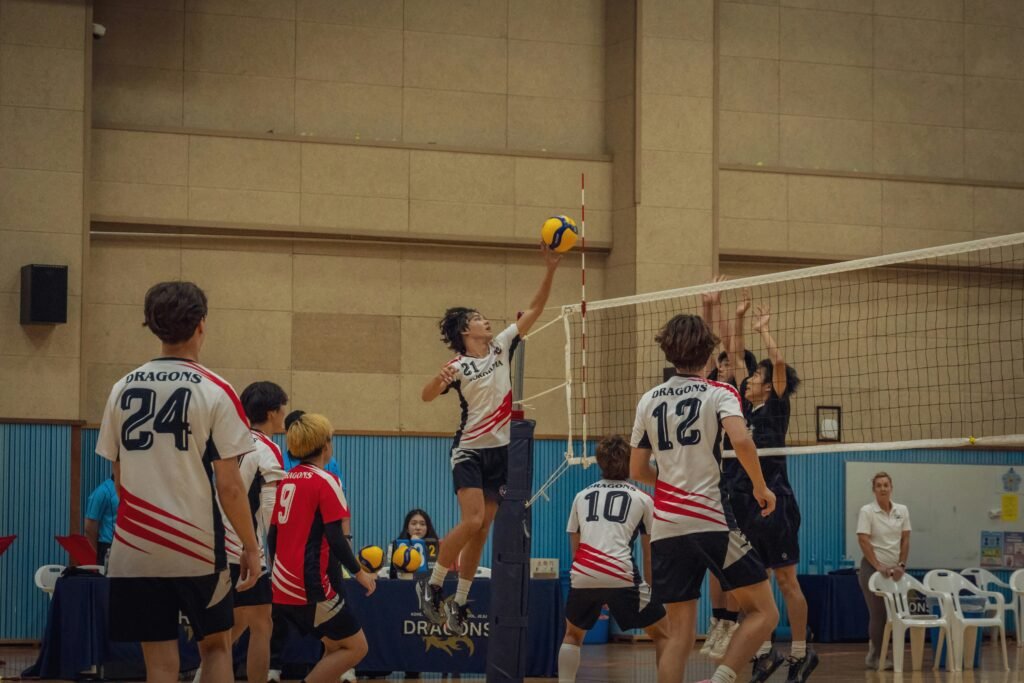


Volleyball is a fast-paced team sport built around serving, passing, setting, attacking and defending. Two teams compete on opposite sides of a net, trying to send the ball into the opponent’s court while preventing it from landing on their own side.
For someone watching volleyball for the first time, the movement can seem complicated. Players rotate around the court, rallies can change quickly and points can be scored in several different situations.
Understanding the basic volleyball rules makes the game much easier to follow.
How Many Players Are on a Volleyball Team?
Indoor volleyball is normally played with six players from each team on the court.
Players have different responsibilities depending on their position and rotation.
Common roles include:
- Setter
- Outside hitter
- Opposite hitter
- Middle blocker
- Libero
- Defensive specialist
Although players have specialized roles, they must rotate according to the rules when their team gains the right to serve.
What Is the Objective of Volleyball?
The main objective is simple:
Send the ball over the net and make it land inside the opponent’s court, or force the opposing team to make an error.
At the same time, a team must defend its own court and prevent the ball from touching the floor.
How Does Volleyball Scoring Work?
Modern indoor volleyball generally uses rally scoring.
That means a point is awarded after every rally, regardless of which team served.
A team can score because:
- The ball lands in the opponent’s court
- The opponent hits the ball out
- The opponent commits a fault
- The opponent touches the net illegally
- The opponent makes a serving error
How Many Sets Are Played?
A standard volleyball match is normally played as a best-of-five format.
The first team to win three sets wins the match.
The first four sets are generally played to 25 points, while a deciding fifth set is played to 15 points.
A team must win a set by at least two points.
For example, a set could finish 25–23 or continue beyond 25 if the score is tied at 24–24.
The Three-Hit Rule
One of the most important volleyball rules is the three-hit limit.
A team generally has up to three contacts to return the ball over the net.
A typical attack may look like:
- Pass
- Set
- Attack
The team does not normally get a fourth contact before sending the ball over the net.
Can a Player Hit the Ball Twice?
A player generally cannot make two consecutive contacts with the ball, although there are exceptions depending on the nature of the first contact.
This is why coordinated team play is so important.
Players must work together to control the ball and organize an attack.
Serving Rules
Every rally begins with a serve.
The server stands behind the end line and sends the ball over the net.
A serve can be performed using different techniques, including:
- Underhand serve
- Overhand serve
- Float serve
- Jump serve
The server must follow the applicable service rules and avoid stepping on or beyond the service line before making contact with the ball.
What Is Rotation?
When a team wins the right to serve after receiving the opponent’s serve, its players rotate.
The six court positions are arranged in a rotational order.
Rotation ensures that players do not simply remain permanently in one part of the court.
However, teams can use tactical positioning after the serve has been made.
What Is a Libero?
The libero is a specialized defensive player.
The libero usually wears a different-colored jersey from the rest of the team.
Their primary role is to improve defensive coverage and ball control.
Liberos have specific restrictions and are generally not used as front-row attackers.
What Counts as a Volleyball Fault?
A fault occurs when a player or team breaks a rule.
Examples can include:
- Serving out
- Hitting the ball out of bounds
- Making too many team contacts
- Carrying or catching the ball
- Illegal rotation
- Certain net violations
- Crossing restricted areas illegally
When a team commits a fault, the opposing team receives the point and, depending on the situation, may gain the serve.
Can the Ball Touch the Net?
Yes.
A ball can touch the net during play and still remain in play if it legally crosses into the opponent’s court.
A serve can also touch the net and continue over it.
The important issue is whether the ball remains within the legal playing area and whether other rules have been violated.
What Happens When the Ball Goes Out?
If the ball lands outside the court boundaries without being touched by an opponent, the team that hit it generally loses the rally.
However, if a defending player touches the ball before it goes out, the situation can change.
This is why players sometimes intentionally allow difficult balls to travel outside the court rather than attempting a risky touch.
Attacking the Ball
Attacks are usually designed to place the ball into difficult areas for the defense.
A powerful spike is one option, but attackers can also use:
- Tips
- Roll shots
- Cross-court attacks
- Line shots
- Soft shots into open areas
Successful attacking involves both power and decision-making.
Blocking
Front-row players can attempt to block an opponent’s attack at the net.
A successful block can immediately stop an attack or redirect the ball back into the opponent’s court.
Blocking also affects how attackers choose their shots.
Why Volleyball Is So Fast
Volleyball does not allow teams to hold possession for long periods.
Players must react quickly because the ball can travel from one side of the court to the other within seconds.
Communication is therefore extremely important.
Players frequently call for the ball and communicate defensive responsibilities during rallies.
Frequently Asked Questions
How many players play volleyball?
Indoor volleyball normally has six players from each team on the court.
How many points are needed to win a volleyball set?
The first four sets are generally played to 25 points with a two-point advantage required. A deciding fifth set is generally played to 15 points, also requiring a two-point advantage.
How many times can a team touch the ball?
A team generally has three contacts to return the ball over the net.
What does a libero do?
A libero is a specialized defensive player who focuses primarily on reception and defensive play.
Conclusion
Volleyball becomes much easier to understand once the basic rules are familiar.
The game revolves around serving, receiving, setting, attacking and defending while teams attempt to score points through successful plays or opponent errors.
With six players on court, rotational responsibilities and fast rallies, volleyball combines teamwork, athleticism and tactical decision-making.