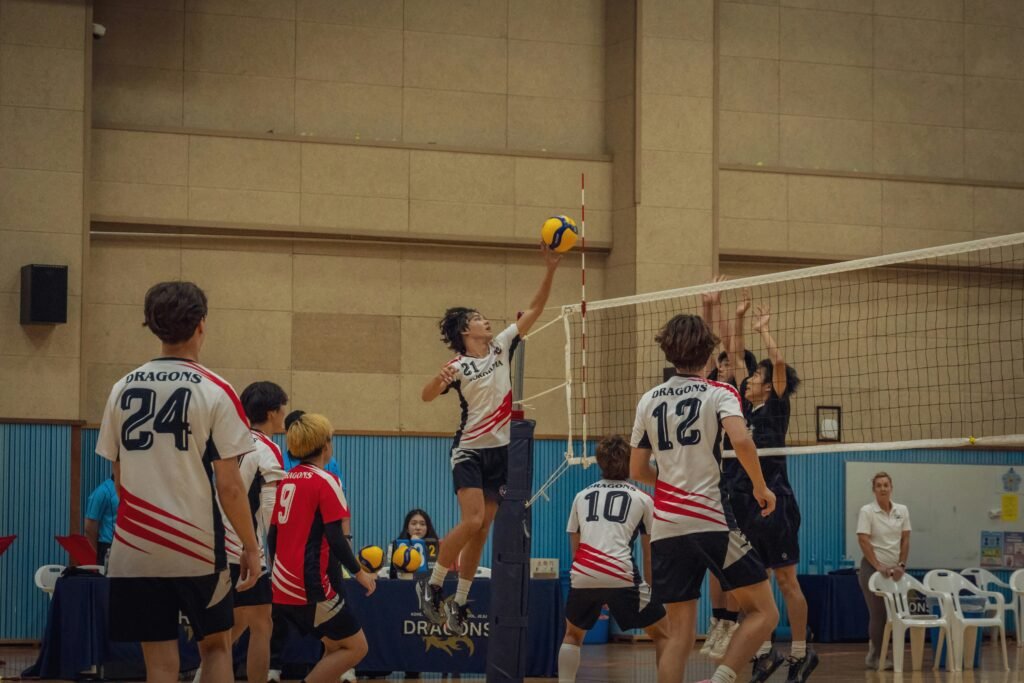


Volleyball can look complicated when players constantly move around the court. Unlike many sports where players remain in relatively fixed positions, volleyball teams rotate through different court positions during a match.
Understanding volleyball rotations makes it much easier to follow the game.
The basic idea is simple: when a team wins the right to serve after receiving the opponent’s serve, its players rotate one position clockwise.
However, there is more to the system than simply moving around the court.
What Is a Volleyball Rotation?
A volleyball rotation determines where the six players must be positioned when a team is receiving a serve.
The six positions are traditionally numbered:
- Position 1 — Right back
- Position 2 — Right front
- Position 3 — Middle front
- Position 4 — Left front
- Position 5 — Left back
- Position 6 — Middle back
When a team wins the right to serve, players rotate clockwise.
The player in position 2 moves into position 1, position 1 moves into position 6, and the rotation continues around the court.
Why Do Volleyball Players Rotate?
Rotation ensures that players take turns occupying different areas of the court.
However, rotation does not mean that a player must remain in that exact location throughout the entire rally.
Once the serve has been contacted, players can move into positions that match their tactical responsibilities.
For example, a setter may move toward the right side of the court to organize the attack.
The Serving Position
Position 1 is especially important because the player there is normally the server.
After the team wins the rally and gains the right to serve, the player who has rotated into position 1 serves.
This creates a predictable serving order throughout the set.
Front Row and Back Row
The six positions can be divided into two groups.
Front Row
Positions 2, 3 and 4 are the front-row positions.
These players can participate in front-row attacking and blocking according to the rules.
Back Row
Positions 1, 5 and 6 make up the back row.
Back-row players have specific restrictions when attacking and blocking.
Understanding this distinction is essential for following volleyball tactics.
What Is a Rotation Fault?
A rotation fault can occur when players are not in the correct relative order at the moment the serve is made.
The referee checks whether players are correctly positioned according to the rotational order.
If a team is incorrectly positioned, the opposing team can receive a point and other consequences depending on the rules being applied.
Why Setters Move During Rotations
Setters often need to move into a specific location after the serve.
Their goal is to be close enough to the net to organize the offense while maintaining the team’s tactical structure.
This is one reason volleyball can appear confusing to new viewers.
The starting formation may look completely different from the formation used during the rally.
The Libero and Rotation
The libero is a specialized defensive player.
Because the libero has specific restrictions, teams use substitutions and replacement rules to place the libero into defensive positions.
This allows teams to strengthen their passing and defensive coverage without changing the overall tactical structure.
Rotation and Team Strategy
Rotation affects how teams organize their offense.
A team might have a particularly strong attacking combination in one rotation and a different configuration in another.
Coaches therefore analyze rotations carefully.
They consider:
- Setter location
- Strong attackers
- Blocking matchups
- Serve-receive formations
- Defensive coverage
- Opponent weaknesses
Serve Receive
When a team is receiving serve, players need to balance two requirements:
- Remain legally positioned before the serve.
- Move efficiently into their preferred playing roles after the serve.
This requires communication and practice.
Experienced teams can transition from the legal starting formation into their attacking system extremely quickly.
Why Rotation Is Important
Rotation adds a tactical layer to volleyball.
It means teams must think about where every player starts while also planning what happens immediately after the serve.
The system rewards teams that can transition smoothly between receiving, attacking and defending.
Frequently Asked Questions
Which direction do volleyball players rotate?
Players traditionally rotate clockwise when their team wins the right to serve after receiving.
Which position serves in volleyball?
The player in position 1 serves.
Do volleyball players stay in their rotation positions?
They must maintain the required relative positions when the serve is made, but can move into tactical positions after the serve.
Why is rotation important?
Rotation determines serving order and creates different offensive and defensive configurations throughout a set.
Conclusion
Volleyball rotations are one of the sport’s most important tactical systems.
Once you understand the six court positions, the clockwise movement and the difference between front-row and back-row players, the game becomes much easier to follow.
Rotation is not simply about moving around the court. It influences serving, attacking, defense and overall team strategy.